
Service 05 · Integration
CRM, WhatsApp and systems integration for South African businesses
Systems integration is the work of connecting separate software systems so that information captured once flows automatically to everywhere it is needed. In a WhatsApp-first market, that very often starts with wiring WhatsApp into your CRM.
The retyping tax
South Africa runs on WhatsApp — but in most businesses, WhatsApp, the website, the CRM and the accounting system do not talk to each other. So staff retype the same information three times, customers repeat themselves to every department, quotes disagree with invoices, and the real history of a customer lives in somebody's phone. Every one of those gaps is paid for in hours and errors: a retyping tax on every transaction. Integration removes it by making your existing systems share information automatically.
Which systems can be integrated?
- Website forms into your CRM, with instant WhatsApp or email alerts to the right salesperson — so a hot lead is answered in minutes, not Monday
- WhatsApp conversations into your customer records and support workflows, so history is never lost when a staff member leaves or a phone does
- CRM, accounting and operational systems kept in sync — quotes, invoices and customer details matching everywhere, without a human re-capturing them
- Internal tools stitched together so a job, order or ticket moves between departments without being retyped at each handoff
- Legacy and niche systems included: where no off-the-shelf connector exists, we build the bridge
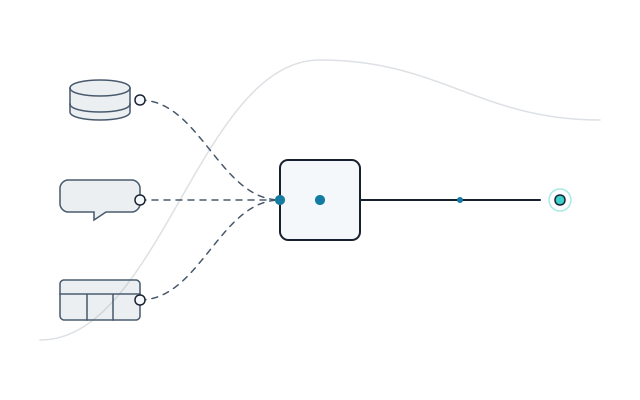
How an integration project runs
-
Map the data flows
Where is each piece of information born, and where does it need to travel? We draw the map with your team — it usually surprises everyone how many times the same fact is captured.
-
Connect without disrupting
Integrations are built and tested alongside your live systems, then switched over carefully. Your team keeps working in the tools they know; the plumbing changes underneath.
-
Document and monitor
Every flow is documented — including what personal information moves where, so the POPIA answer is easy to give — and monitored, so a failed sync is flagged, not discovered weeks later.
Where does systems integration fit?
A Johannesburg sales team can see every enquiry — web, email or WhatsApp — in one pipeline. A field-services business in Pretoria can schedule, invoice and follow up from a single flow instead of four disconnected apps. A Cape Town retailer can have online orders, stock and accounting agree with each other by design. A growing SME can finally get one version of the truth about each customer — which is also the foundation every dashboard and AI agent is built on.
Common questions
Can WhatsApp really be connected to a CRM?
Yes. Through the WhatsApp Business API, customer conversations can be logged against CRM records, routed to the right person, and even answered by an AI agent for routine questions. The result is that WhatsApp stops being a black hole of customer history and becomes a proper, auditable channel.
Will integration disrupt the systems we already run?
It should not, and we design so it does not: integrations are additive, built against test data first, and switched over in stages. Your team keeps using the same familiar screens — the difference is that information now arrives in them automatically.
Related services: workflow automation, business intelligence and AI agents — or see all services.
Read more: what you can legitimately automate on WhatsApp and what an integration typically costs, plus the rest of our automation insights.
Do your systems talk to each other?
If the honest answer is no, a free 30-minute strategy session will map which connection would save your team the most retyping — and what it would take to build it.